Device Plugin and DRA
Kubernetes has two ways to hand a device to a Pod: the device plugin API and Dynamic Resource Allocation (DRA). Classic HAMi uses a device plugin. HAMi-DRA uses DRA.
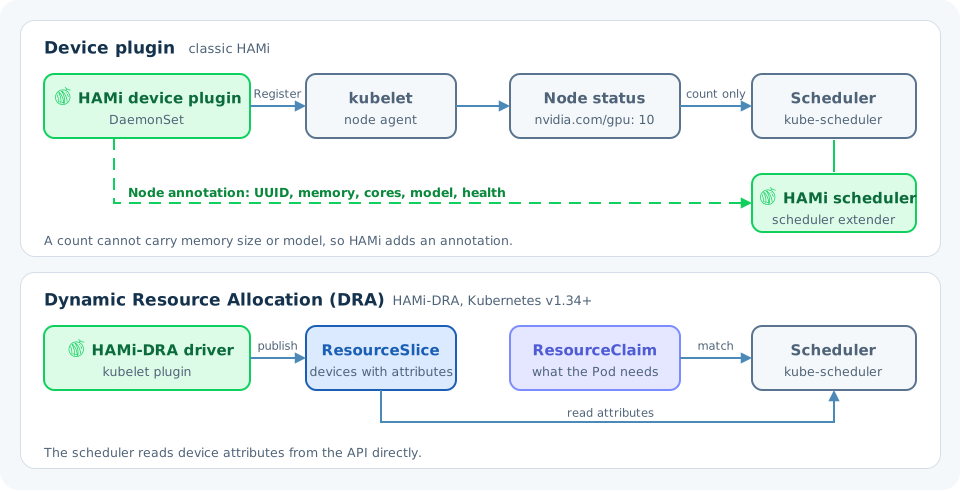
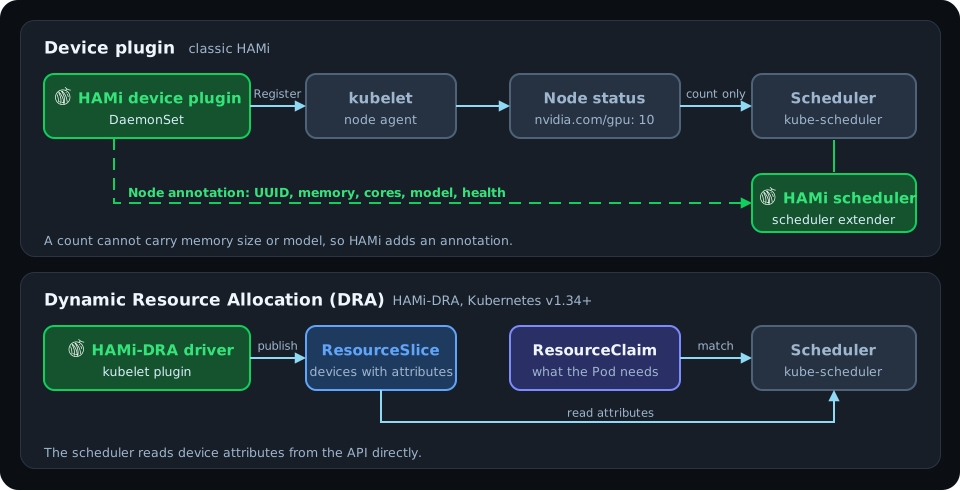
Device plugin
A device plugin runs as a DaemonSet on each GPU node. It does three things:
- Register with kubelet under a resource name such as
nvidia.com/gpu. - Report its devices, each with an ID and a health state. kubelet publishes the count in the node's capacity.
- Allocate a device when a Pod starts on the node. kubelet calls the plugin, and the plugin returns the device files, mounts, and environment variables for the container.
The scheduler sees only that count. It learns that a node has 4 GPUs, and nothing about their memory or model. For a whole-card request that is enough. To place a 3000 MiB slice, the scheduler needs more.
HAMi fills the gap in two ways:
- The HAMi device plugin reports each card
deviceSplitCounttimes (10 by default), so up to 10 Pods can hold a share of one card. A node with one GPU showsnvidia.com/gpu: 10. - It writes each card's details to the node annotation
hami.io/node-nvidia-register: UUID, memory, compute, model, NUMA node, and health. The HAMi scheduler reads this annotation to pick a card.
See Protocol design for how the scheduler and device plugin pass decisions through annotations.
Dynamic Resource Allocation
DRA reached general availability in Kubernetes v1.34. It describes devices and requests with these API objects:
| Object | Role |
|---|---|
ResourceSlice | Published by the DRA driver. Lists each device with its attributes. |
DeviceClass | A named set of devices, selected by attributes. |
ResourceClaim | A Pod's request for devices, similar to a PersistentVolumeClaim. |
ResourceClaimTemplate | A template the Pod references. Kubernetes creates a ResourceClaim from it for each Pod. |
The scheduler reads device attributes from ResourceSlice objects directly, so no annotation is needed.
HAMi-DRA keeps the HAMi Pod spec. Its webhook converts nvidia.com/gpu, nvidia.com/gpumem, and nvidia.com/gpucores into a ResourceClaim. HAMi-Core still enforces the limits inside the container, so isolation works the same way in both modes.
Which one to use
HAMi-DRA needs Kubernetes v1.34 or later with the DRA Consumable Capacity feature gate, plus CDI in the container runtime. On any other cluster, use classic HAMi. Choose your setup has the full comparison.
